- Mon - Fri: 09:00 - 17:30

Perovskite-based photoabsorbers have a low material criticality, a high light absorption capacity and can achieve specific optical properties by adjusting the chemical composition. This makes perovskites interesting for use in multi-junction solar cells: by stacking several perovskite solar cells with different band gaps, the efficiency can be significantly increased and exceed the theoretical maximum of single-junction solar cells. we are working on the development of scalable manufacturing processes for perovskite solar cells and modules. The focus here is on low-temperature processes in which functional layers are deposited or printed from solution. This makes it possible to produce the components on flexible substrates in order to open up new fields of application – particularly in the area of integrated photovoltaics. We conduct our research at an international level and are a point of contact for industrial and academic players in the field of coating technology, cell production and system integration.
Technology strategy
Roll-to-roll coating line for novel PV technologies.
we are working on the next-generation solar cell technologies, placing particular emphasis on organic and perovskite solar cells. Both technologies have in common that the materials used can be applied from solution at low temperatures by coating and printing processes. This makes production on roll-to-roll equipment possible, thus opening up enormous potential for large production volumes and low manufacturing costs.
We have laboratory lines for processing under inert gas. Currently, three glovebox lines with spin coaters, vacuum evaporators and various automated basic characterization processes are in operation. Solar cells are produced on these lines under exclusion of oxygen and water in order to test and optimize new materials and layer stacks.
To mitigate climate change, decarbonization of the energy sector is a key challenge. Photovoltaics plays a crucial role in the widespread introduction of a clean and affordable energy infrastructure. Due to the predominance of imports from outside the EU and the need for energy-intensive purification of raw materials, established photovoltaic modules are associated with supply risks and a high carbon footprint. Emerging perovskite PV has enormous potential to overcome these problems and revolutionize the EU energy sector.
The DIOSSOL project aims to produce ultra-stable, highly efficient and cost-effective perovskite solar cells and modules with minimal environmental footprint.

Perovskite photovoltaics have the potential to contribute significantly to the transition to clean electrical energy due to available raw materials and an excellent sustainability profile. By changing the composition of perovskite materials, their band gaps can be tuned to absorb light in a complementary manner. By combining the materials in a tandem solar cell, it becomes possible to exceed the theoretical efficiency limit of a single solar cell. The DIOSSL project aims to develop manufacturing technologies for 2-terminal tandem cells and monolithically connected modules on flexible films using low-cost perovskite absorber layers. Low production and power costs can be achieved by applying scalable manufacturing processes on film substrates. The modules produced will be characterized by high efficiency, excellent stability and a positive sustainability profile. Important aspects of the project include minimizing the use and impact of scarce and critical materials by using sustainable, abundant materials and applying encapsulation and recycling strategies to ensure recyclability.
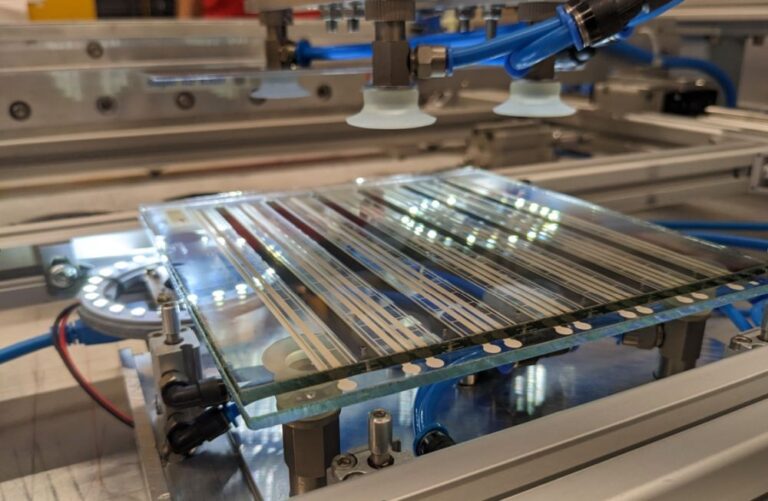
Perovskite solar cells are a rapidly growing research topic. Laboratory efficiencies of up to 25% have already been achieved for small-area solar cells. Because of their sensitivity to oxygen and humidity, hermetic encapsulation must be ensured. The use of chemically stable electrode materials such as micrographite and a highly scalable manufacturing concept are also required.perovskite solar modules (16 x 16 cm²) with a stable solar efficiency of 20% are to be manufactured for the first time in a highly scalable manner using the DIOSSOL process. The modules are manufactured completely on continuous glass substrates in a unique "reverse manufacturing" approach. This goal places high demands on the precision of the manufacturing steps. A new development of process technology from the fields of glass structuring by wet chemistry and laser as well as ink-jet coating technology, furnace technology and the in-situ crystallization of perovskite melts is being carried out.
中国 +8618100063144